Vision
To establish a transparent and performance-focused distributor recognition framework that encourages professional excellence, rewards genuine business achievements, and supports sustainable market development.


Published On - October 15,2026
A practical guide to ClickBaitPays registration, cryptocurrency deposits, advertising campaigns, potential earnings, withdrawal rules, and important risks to consider before joining.
ClickBaitPays describes itself as a paid-to-click (PTC) advertising platform. Its stated model connects advertisers seeking website traffic with members who view eligible advertisements. The platform says members can earn cryptocurrency for qualifying ad clicks and may also receive commissions from direct referrals.
However, participation is not simply a matter of registering and clicking ads for free. According to the platform's official instructions, members who want to earn through campaigns must fund an account with cryptocurrency, purchase an advertising campaign, and pay a one-time activation fee. Earnings are subject to campaign rules, a holding period, and withdrawal conditions.
This guide explains the process step by step, outlines the costs and payment rules published by the platform, and highlights what prospective members should check before risking money. The information below describes the platform's stated system; it does not guarantee that users will earn a profit or successfully withdraw funds.
ClickBaitPays is a website that presents a paid-to-click advertising model. In general, PTC platforms offer advertisers exposure to viewers and provide participating users with rewards for completing eligible viewing activities.
ClickBaitPays describes two main sides of its service:
The website also advertises a direct referral commission. Its official FAQ says referrals are optional for members who earn through their own ad-click activity.
The company publishes instructions, campaign details, terms, and frequently asked questions on its website. Those materials are the primary sources for understanding the platform's rules. Nevertheless, published campaign examples should not be treated as independent verification of typical earnings, business sustainability, or withdrawal reliability.
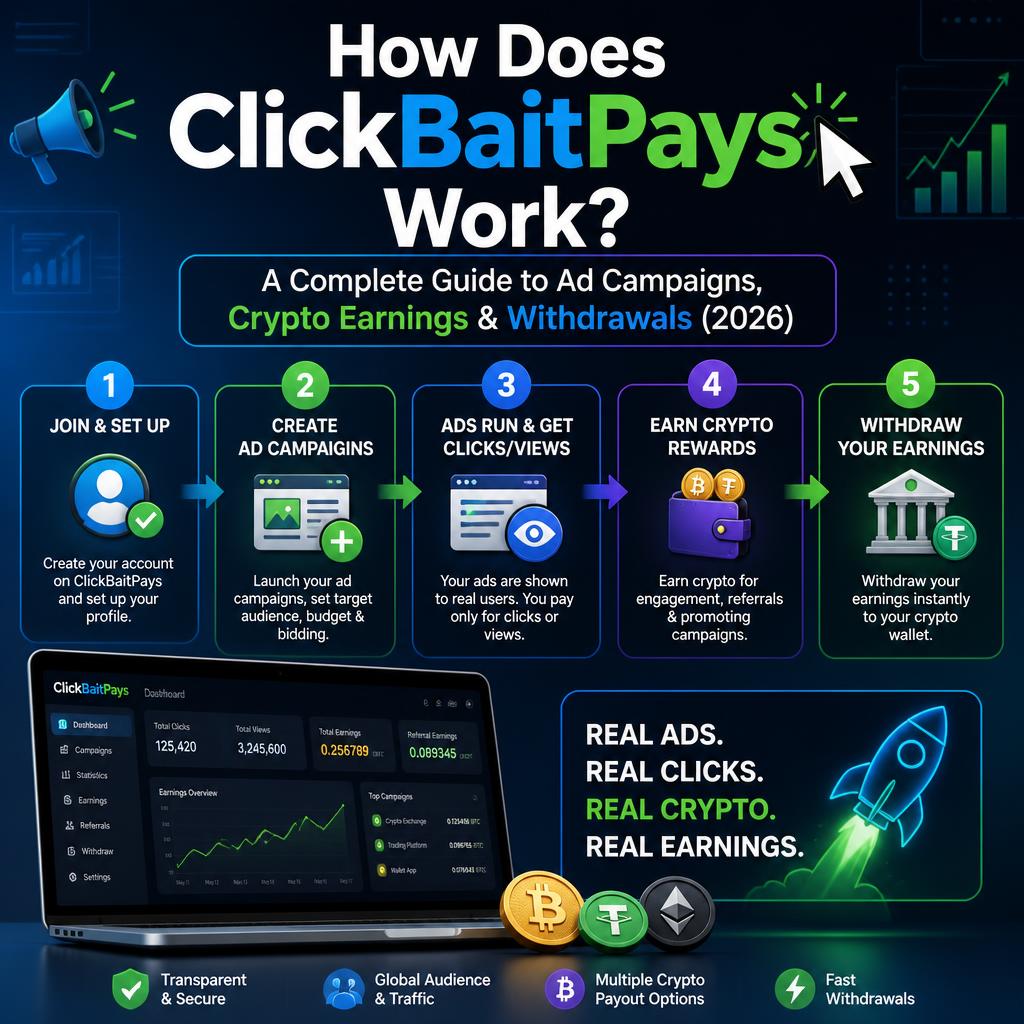
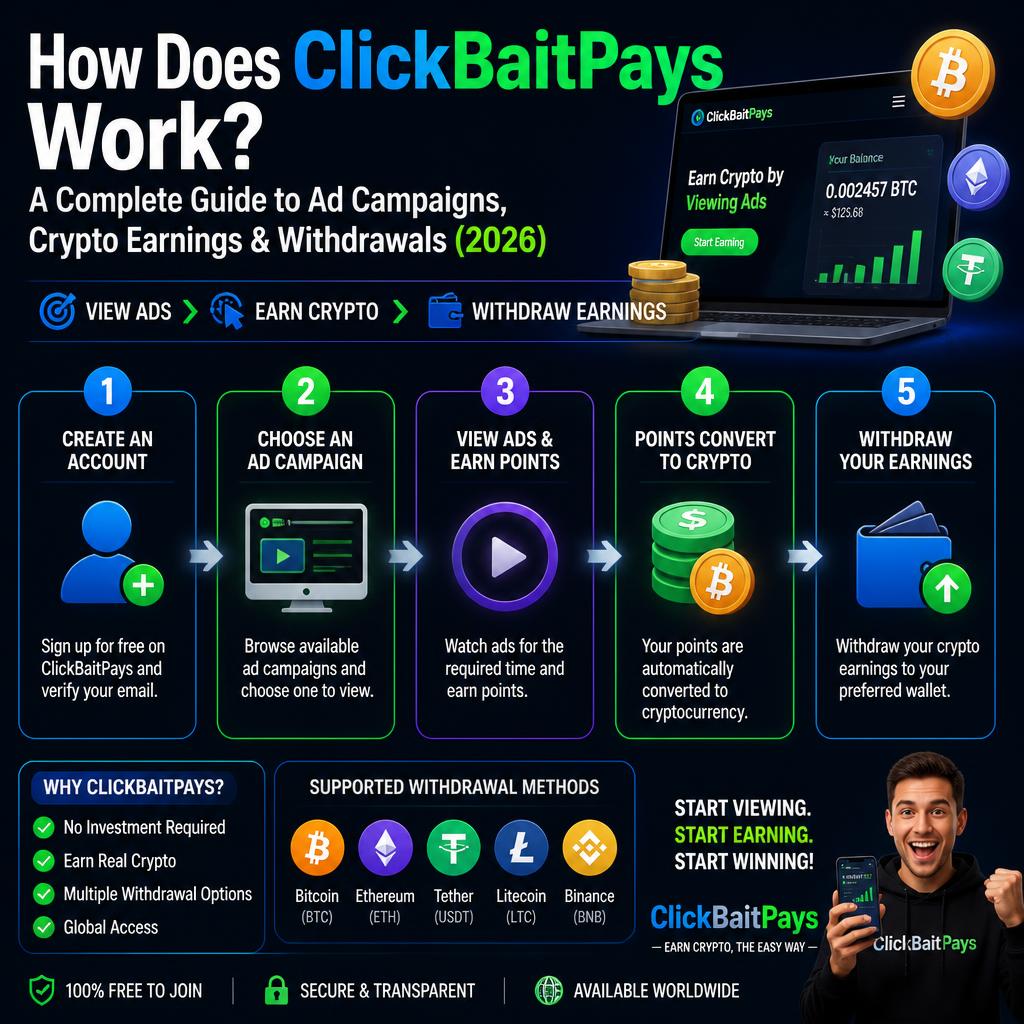
According to the official FAQ and getting-started guide, the process involves several stages.
Users begin by registering on the official website and verifying their email address. The platform's published rules specify that registration should take place using a home IP address and prohibit VPN use during signup.
Before registering, read the current terms and account rules. The platform limits the number of accounts permitted per person and sets additional conditions for multiple accounts within a household. Violations involving multiple accounts, proxies, bots, or automated activity may lead to account suspension or deletion under its stated policies.
Use the official domain and be cautious of imitation websites or unsolicited messages claiming to represent the service.
The platform instructs members to deposit cryptocurrency through its deposit process. Its FAQ describes a payment flow that uses a third-party cryptocurrency payment processor and says users should follow the exact asset, amount, and wallet instructions shown for each transaction.
Before sending money, verify the amount, network, destination address, and payment instructions. Never rely on an old wallet address or an address copied from an unrelated message.
After funding the account, members select an available campaign level and purchase it. The platform's instructions describe different campaign levels with different costs and click-related rules.
Campaign pricing determines the amount a member commits and the terms associated with the selected level. Check the current campaign page before deciding, because pricing and conditions may change.
Do not choose a campaign simply because a larger level displays a larger earning figure. First determine whether the full cost is affordable and whether you understand the conditions attached to the campaign.
ClickBaitPays states that members must pay a one-time activation fee for the chosen campaign level before the relevant ad-click earning activity is enabled.
This is a key difference between the platform and a conventional free online task. A member must commit funds before qualifying for the advertised campaign activity.
Calculate the total initial outlay by adding the campaign purchase and activation fee. Include any cryptocurrency transaction charges or conversion costs that may apply.
After the campaign is activated, members can access the platform's ad-clicking section and view eligible advertisements. ClickBaitPays states that users receive 90% of the applicable cost per click when they complete the required viewing activity.
The amount depends on the selected campaign level and the platform's current rules. The displayed amount should not be interpreted as guaranteed profit because the user has already committed money and may face additional costs or withdrawal fees.
The platform prohibits automated clicking methods, including bots, scripts, and auto-clickers. Members should follow its viewing instructions and avoid any attempt to manipulate traffic or activity.
The platform's FAQ describes a 12-day campaign period followed by a seven-day holding period before campaign earnings are transferred to the available balance.
This means a balance shown as earned during a campaign may not immediately be available for withdrawal. Members should distinguish between campaign earnings that remain on hold and funds that the platform identifies as available.
Confirm the current timing in the official dashboard before making financial plans based on expected withdrawals.
ClickBaitPays states that eligible members can request withdrawals to a cryptocurrency wallet once the required minimum balance is available. Its published FAQ specifies a minimum withdrawal of 10 USDT and a 10% withdrawal fee.
The platform also says withdrawals may be requested once per week and are processed manually by its administrative team. Processing is therefore not described as instant or fully automatic.
Before participating, read the current withdrawal terms and understand that a displayed account balance is not the same as cryptocurrency already received in your own wallet.
ClickBaitPays publishes campaign examples with different costs, numbers of daily ads, and stated cost-per-click amounts. It says the member receives 90% of the applicable cost per click, with the remaining portion not credited to the viewer.
These figures explain the platform's advertised calculation method; they do not establish typical net profit or guarantee that a member will recover the money spent.
To evaluate the financial side, consider:
A campaign's stated completion value should not be confused with money already withdrawn. Even when a platform displays a positive balance, the user should consider whether the amount is available, what fees apply, and whether the initial cost has been recovered.
For additional context, read this ClickBaitPays online earning opportunities article. Treat promotional examples and testimonials cautiously and look for independently verifiable evidence.
According to the official FAQ, referrals are not required to participate in the platform's own ad-click activity. Members may also qualify for a direct referral commission under the published rules.
The FAQ describes a 10% commission on qualifying clicks made by direct referrals. Members should check the latest terms to confirm which actions qualify and how commissions are credited.
A referral commission is an additional potential earning method, not a guarantee of income. If you share information about ClickBaitPays, describe the costs and conditions accurately. Do not promise guaranteed earnings, portray the service as an investment, or imply that recruiting people automatically creates a profitable business.
The most important financial consideration is that the platform requires a campaign purchase and an activation fee before the advertised earning activity begins.
The platform's FAQ states that a 10% withdrawal fee applies. Verify the current fee and any additional network or wallet charges before making a transaction.
Campaign earnings are subject to the stated campaign and holding timelines before becoming available.
The platform says withdrawal requests are handled manually, so users should not assume instant payment.
Cryptocurrency prices can fluctuate, transfers can be irreversible, and mistakes may be difficult to correct.
The platform prohibits automated activity and certain methods of masking identity. Violations may lead to account loss under its stated policies.
Advertised campaign calculations do not independently prove typical net returns or future payout performance.
These factors should be considered together rather than evaluating the opportunity using a single advertised per-click figure.
A responsible assessment separates what a platform says it does from what can be independently verified. ClickBaitPays publishes a website, FAQ, terms, campaign instructions, and withdrawal conditions. Those materials help explain its stated process, but they do not by themselves establish that every member will earn a profit or receive a withdrawal without difficulty.
Independent research is important when a platform requires users to deposit cryptocurrency before participating.
The US Federal Trade Commission warns about online task scams that promise money for simple activities but later require people to deposit their own funds, often cryptocurrency, to continue tasks or unlock supposed earnings. This is a general consumer warning—not a finding that ClickBaitPays itself has been identified as a scam.
Read the FTC's guidance, How to Spot and Avoid Task Scams, before committing funds to any similar online earning opportunity.
Also review the FTC's guidance on cryptocurrency scams, which explains why crypto payments can be difficult to recover. If you cannot independently evaluate the platform's terms, operator information, and withdrawal evidence, consider not depositing money.
Use this checklist before making a decision:
Published By -Admin
Published On - October 14,2026
A proposed framework for distributor recognition, sales achievement, performance incentives, market development, and sustainable business growth.
The ZILARA Exclusive Distributor Bonuses, Performance Incentives & Strategic Business Growth Rewards Program is a proposed incentive framework designed to recognize distributor performance, encourage sales development, reward business achievements, and support sustainable business growth.
In a competitive business environment, distributors play an important role in connecting products with customers, developing new markets, maintaining business relationships, and expanding sales networks. A structured rewards program can help recognize these contributions and encourage distributors to pursue clear, measurable business objectives.
The purpose of the ZILARA rewards concept is to establish a transparent and organized approach to distributor recognition, performance incentives, sales achievements, and business development rewards. Any actual benefits offered under the program would be determined by ZILARA's approved policies, eligibility conditions, and official incentive structure.
A distributor performance bonus is an incentive that may be linked to the achievement of predefined sales targets, distribution objectives, or other approved business performance measures.
Under a formally established ZILARA program, eligible distributors could be assessed according to agreed criteria such as completed sales, verified business transactions, customer development, product distribution, and compliance with company policies.
The objective is to recognize consistent performance and encourage distributors to maintain professional business practices. Clear targets, defined assessment periods, and documented eligibility requirements can help ensure that distributors understand how performance is evaluated.
Any bonus amount, percentage, or payment schedule should be published in the official program rules rather than assumed or promised without authorization.
Sales achievement incentives recognize distributors who meet or exceed established sales objectives during a specified period.
These incentives may be structured around monthly, quarterly, or annual performance targets, depending on the company's approved business model.
A sales achievement program can encourage distributors to improve customer service, strengthen retailer relationships, expand product reach, and maintain consistent sales activity.
Performance should be evaluated using reliable records and clearly defined rules. Returns, cancellations, unpaid transactions, and other relevant adjustments should be addressed in advance so that bonus calculations remain fair and understandable.
Expanding into new markets can create opportunities for businesses to reach additional customers and strengthen their distribution networks.
A market development incentive may recognize eligible distributors who successfully establish approved business relationships, develop new sales territories, or increase product availability in underserved markets.
Possible evaluation criteria include verified new customer accounts, approved retail partnerships, completed sales, and measurable market development achievements.
The purpose is to encourage responsible expansion based on genuine customer demand and sustainable commercial opportunities.
A well-organized distribution network can support product availability, market coverage, and customer relationships.
Where permitted by the company's business model, a network development incentive may recognize distributors for establishing productive relationships with eligible dealers, retailers, wholesalers, or other approved channel partners.
Recognition should be based on genuine business activity and measurable contributions, such as active accounts, completed transactions, service quality, and compliance with distribution standards.
Any incentive connected to team or network performance should use clearly documented criteria. Rewards should not depend solely on recruiting participants or collecting joining fees; the program should emphasize legitimate product sales and genuine commercial value.
Leadership recognition may be used to acknowledge distributors who demonstrate professionalism, reliable communication, customer service, responsible market development, and consistent achievement of approved business objectives.
Recognition could take the form of certificates, awards, special business acknowledgments, invitations to company events, or other benefits formally approved by ZILARA-related community channels.
A leadership program should use objective and consistently applied criteria. Recognition should reflect genuine contributions rather than unverified claims or guaranteed business outcomes.
Customer relationships are essential to sustainable business growth. Distributors who provide reliable service, communicate product information accurately, and maintain professional relationships can contribute to customer satisfaction and repeat business.
A service excellence incentive may recognize approved measures such as customer feedback, timely communication, responsible handling of customer concerns, and compliance with service standards.
This category encourages distributors to focus on long-term customer relationships rather than short-term sales alone.
A company may establish special incentive campaigns for particular occasions, product launches, business milestones, or seasonal sales periods.
Such campaigns could recognize eligible achievements within a defined timeframe. Each campaign should specify its duration, qualifying transactions, performance targets, applicable exclusions, and reward conditions.
Special bonuses should be announced through official company communications and applied consistently to eligible participants.
A transparent incentive program requires clear eligibility rules and a reliable verification process.
Depending on the approved program, eligibility may require active distributor status, compliance with company policies, verified qualifying sales, accurate business records, and completion of any applicable documentation.
The company should explain how performance is measured, when results are reviewed, how returns and cancellations are handled, and how distributors can raise questions about an assessment.
No participant should be led to believe that a bonus is automatic, guaranteed, or already approved unless the official terms expressly establish that entitlement.
The bonus calculation method should be communicated before a performance period begins.
For example, an official policy could specify a fixed reward for achieving a target or a defined percentage of qualifying net sales. These are possible structures, not confirmed ZILARA rates or benefits.
The company should clearly state the applicable currency, calculation method, assessment period, payment timeline, tax treatment where relevant, and any minimum requirements or exclusions.
Records of qualifying activity and approved payouts should be maintained to support accurate calculations and help resolve disputes.
The long-term value of a distributor rewards program depends on trust, transparency, and responsible administration.
All incentives should be consistent with applicable laws, company policies, consumer protection requirements, tax obligations, and any relevant direct-selling or distribution regulations.
The program should avoid misleading income claims, unrealistic earnings promises, undisclosed conditions, and rewards that encourage artificial purchases or unsustainable inventory accumulation.
Where network-based incentives are permitted, eligibility and compensation should be tied to legitimate business activity under a documented and compliant structure.
To establish a transparent and performance-focused distributor recognition framework that encourages professional excellence, rewards genuine business achievements, and supports sustainable market development.
To recognize eligible distributor contributions through clearly defined incentives, measurable performance objectives, responsible business practices, and consistent communication of rewards and eligibility requirements.
A well-designed distributor incentive program can help a business encourage sales consistency, strengthen channel relationships, improve customer service, and recognize meaningful achievements.
It can also support distributor engagement by providing clear objectives and a transparent method for evaluating progress.
However, results depend on the suitability of the incentive structure, product demand, commercial conditions, operational support, and effective program management. No particular sales result, bonus amount, or income level should be assumed without verified terms and evidence.
The ZILARA Exclusive Distributor Bonuses, Performance Incentives & Strategic Business Growth Rewards Program represents a proposed framework for recognizing performance, encouraging responsible business development, and acknowledging eligible distributor achievements.
By combining clear targets, transparent calculations, fair eligibility standards, and a commitment to legitimate commercial activity, a formally approved program can provide distributors with a clearer understanding of how their contributions may be recognized.
The guiding principle is simple: recognize genuine performance, reward verified achievements, and encourage sustainable business growth.
ZILARA — Recognizing Performance, Rewarding Achievement, Inspiring Growth.
Visit the official ZILARA website to review available company information and verify any current distributor incentives or rewards.
.jpg)

Published By -Admin
Published On - October 14,2026
An overview of the potential advantages and disadvantages of ORYGN, including product value, customer experience, business costs, compensation conditions, and important questions to consider before making a decision.
When researching ORYGN in 2026, one of the most important steps is understanding its potential advantages and disadvantages before making a decision. ORYGN operates in the wellness market and presents products alongside a potential business opportunity. However, the suitability of the company depends on what you want to achieve, how much you are willing to spend, and whether its products and business terms meet your expectations.
Some people may be interested in purchasing wellness products for personal use, while others may want to investigate the opportunity to promote products and earn commissions. These are different goals and should be evaluated separately.
This ORYGN pros and cons review examines the factors prospective customers and distributors should consider. It also explains which details need verification before purchasing products, registering for membership, or committing to a business opportunity.
ORYGN is a wellness-focused brand associated with products and a business opportunity. People researching the company may want information about its product range, membership options, compensation arrangements, and potential costs.
Before drawing conclusions about the company, it is important to review current official information. Product availability, business policies, and registration conditions can change over time and may vary by country.
For a balanced evaluation, consider three separate areas:
A positive experience in one area does not automatically establish that every other area is equally attractive.
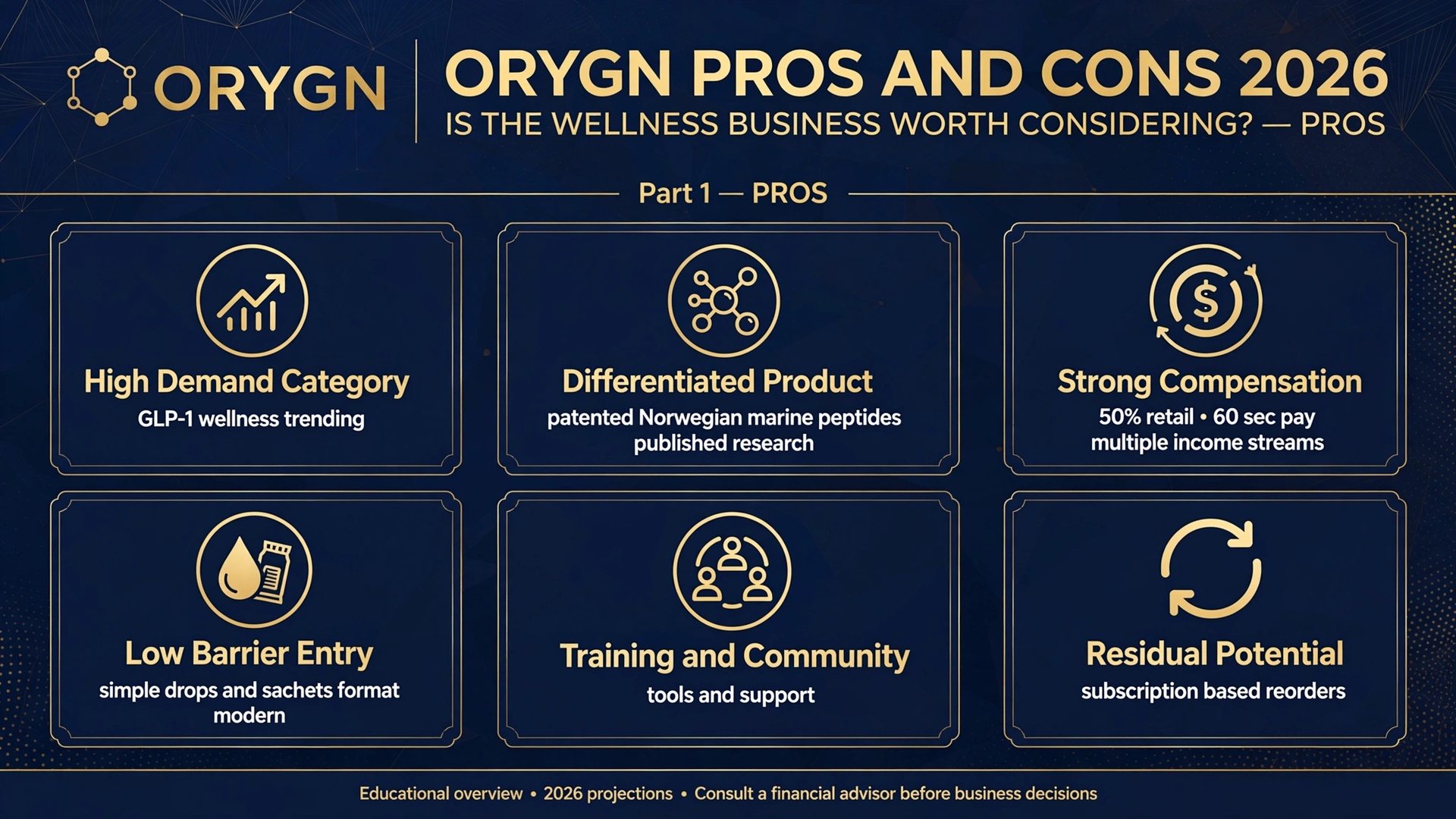
Wellness is a broad market that includes products intended to support different aspects of everyday wellbeing. People already interested in this category may wish to explore whether ORYGN's offerings fit their preferences.
However, the size of the wellness market does not guarantee demand for a particular brand. Before purchasing, review individual product descriptions, labels, prices, and available evidence supporting any advertised benefits.
The most useful question is whether a specific product offers value to you, not simply whether wellness is a popular industry.
For individuals interested in entrepreneurship, ORYGN's business opportunity may be worth investigating. Depending on the current program terms, participants may have the opportunity to promote products and receive compensation for qualifying activities.
Before joining, obtain the official compensation plan and determine exactly how participants qualify for payment. Confirm whether commissions are tied to retail sales, eligible team activity, or other requirements.
A business opportunity should be evaluated using documented rules rather than verbal promises or promotional presentations.
A product-based business may allow participants to build relationships with customers by offering product information, answering questions, and providing service after a sale.
Repeat purchases can be valuable when customers genuinely appreciate a product and find its price reasonable. However, repeat demand should be demonstrated through real customer behavior rather than assumed from distributor enthusiasm.
Anyone considering ORYGN as a business should investigate whether independent customers are interested in the products without being asked to join the business opportunity.
Participating in a direct-sales business can provide experience with communication, customer service, product education, and basic business planning.
These skills can be useful in other commercial settings as well. Nevertheless, learning opportunities should not be confused with guaranteed financial returns.
Prospective participants should consider whether the time, training requirements, and expenses are appropriate for their goals.
One advantage for prospective customers and distributors is that they can evaluate many important details before making a decision.
They can request product labels, compare prices, read membership terms, review refund policies, and ask for written compensation information.
Taking time to complete this research can help people avoid unexpected expenses and make decisions based on evidence instead of pressure.
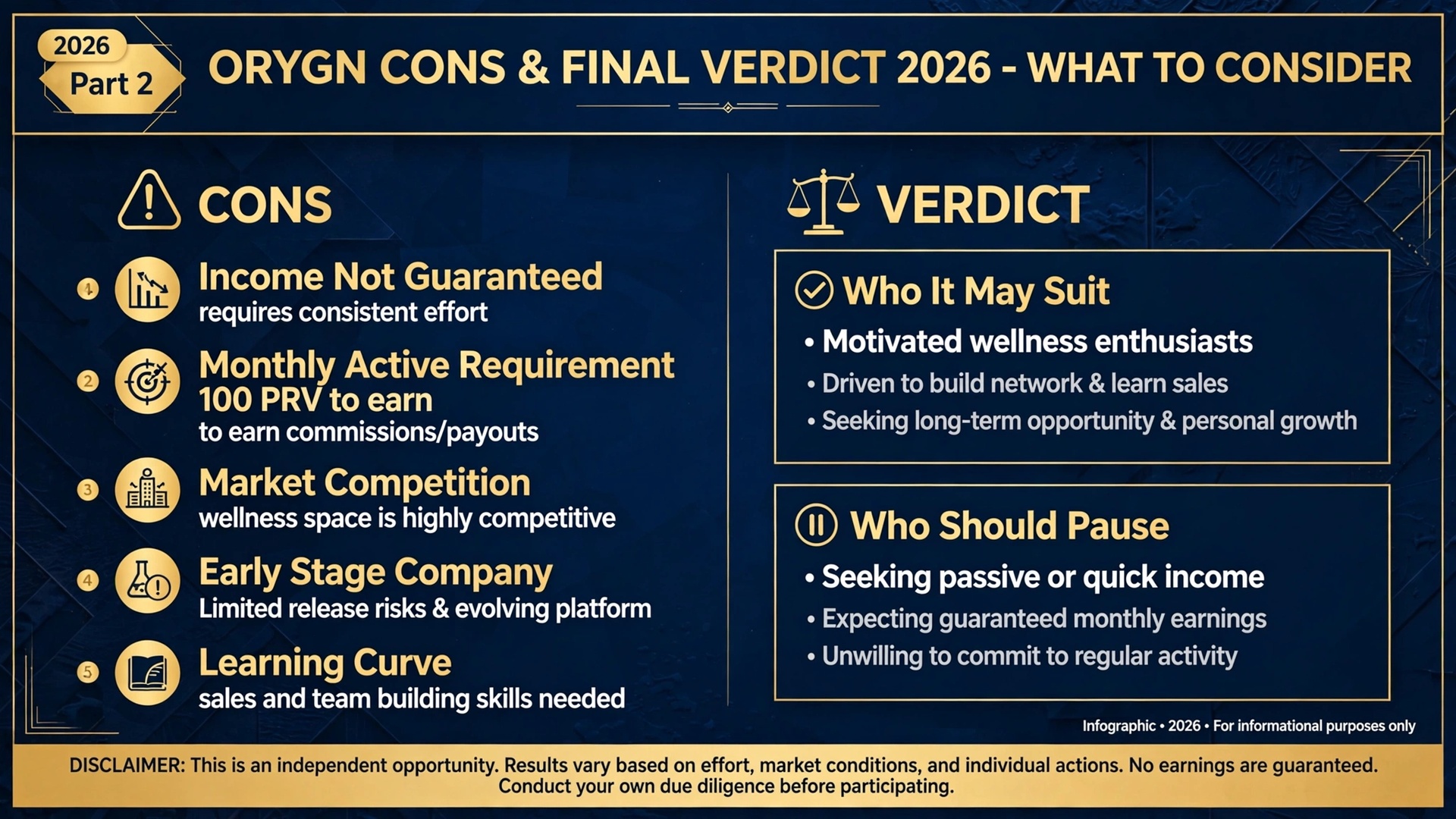
The possibility of earning commissions is not proof that participants will make money. Results may depend on product demand, sales ability, customer retention, eligible business activity, and expenses.
Some participants in direct-sales opportunities may earn commissions, while others may earn little or nothing. Without reliable company-specific income information, it is not possible to predict what an ORYGN participant will earn.
Request an official income disclosure statement if available. Check whether reported amounts represent gross commissions or actual profit after expenses.
An opportunity may involve more than an initial registration payment. Depending on the current terms and the participant's activities, costs could include product purchases, shipping, advertising, travel, training, and other operating expenses.
Not every expense necessarily applies to every participant, so ask for a complete fee schedule and identify which purchases are optional or required.
Create a realistic budget before joining. If your projected sales cannot reasonably cover your expenses, the opportunity may not be financially suitable.
A wellness product can attract interest without necessarily generating sustainable sales. Product demand depends on factors such as pricing, customer preferences, competition, quality, and repeat-purchase behavior.
Before building a business around ORYGN, compare its products with alternatives available to consumers. Ask whether the value proposition is clear and whether potential customers would purchase the products at their regular price.
A business that depends heavily on continually finding new distributors rather than serving genuine product demand deserves careful examination.
Business compensation plans can include qualification requirements, commission categories, rank conditions, or other rules. If a plan is difficult to understand, participants may struggle to estimate their likely income or identify what activities are necessary to qualify.
Ask for the current written plan and request explanations of unfamiliar terms.
Pay particular attention to minimum sales requirements, eligibility conditions, payment timing, and the circumstances under which commissions may be withheld or reversed.
Do not make a financial commitment until you understand the rules that apply to your participation.
Wellness marketing can sometimes create expectations that go beyond what available evidence supports. A product description or customer testimonial should not automatically be treated as proof of a medical benefit.
Review the official label and supporting evidence for any product you are considering. Avoid relying on claims that a product can cure diseases or replace appropriate medical care unless such claims are properly established and legally permitted.
Consumers with health conditions or medication concerns should consult a qualified healthcare professional before using relevant supplements.
Membership agreements can affect recurring payments, account status, product returns, and the ability to leave the business.
Before registering, determine whether there are renewal fees, recurring orders, minimum purchase requirements, or cancellation deadlines. Read the return policy carefully and keep copies of important documents.
These details should be verified from the current terms rather than assumed from a representative's explanation.
A fair assessment requires evidence. The presence of wellness products or a business opportunity alone does not prove that a company is legitimate, and uncertainty about a particular policy does not by itself prove that a company is a scam.
To evaluate ORYGN responsibly, investigate its legal business identity, official contact information, product documentation, distributor agreement, compensation plan, and refund policies.
Also consider how the opportunity is presented. Be cautious if anyone guarantees income, pressures you to make an immediate purchase, discourages independent research, or refuses to provide written terms.
If you identify specific concerns, examine the supporting documents and applicable consumer-protection rules. Avoid relying entirely on anonymous online statements or promotional testimonials when reaching a conclusion.
The goal is to establish what can be verified, what remains uncertain, and whether the risks are acceptable to you.
The best decision may depend on whether you are interested in the products or the business opportunity.
| Consideration | Customer | Potential Distributor |
|---|---|---|
| Main objective | Buy products that meet personal needs. | Sell products and potentially earn commissions. |
| Main financial concern | Product price and recurring purchase terms. | Setup costs, operating expenses, and profitability. |
| Key documents | Product labels, prices, and return policy. | Compensation plan, distributor agreement, and income disclosures. |
| Important question | Is the product worth its price? | Can I generate profitable sales under the actual rules? |
| Main risk | Paying for a product that does not meet expectations. | Spending time and money without generating a profit. |
A customer does not necessarily need to participate in a business opportunity to evaluate a product. Likewise, a potential distributor should not assume that personal satisfaction with a product automatically translates into commercial success.
Before committing to the opportunity, obtain clear answers to these questions:
Written answers are more useful than informal assurances because they can be checked against the company's current policies.
The ORYGN pros and cons depend on your goals, financial situation, and the information you can verify about the company.
For customers, the key considerations are product suitability, price, product documentation, and return terms. For potential distributors, the analysis must go further and include the compensation plan, customer demand, operating costs, and the likelihood of generating sales that exceed expenses.
Potential advantages such as product choice, sales experience, and customer relationships may be worth exploring. However, uncertain earnings, business expenses, compensation requirements, and the need to verify product claims should not be overlooked.
Before making a decision in 2026, review ORYGN's current official documents and calculate the financial commitment involved. Do not borrow money, rely on guaranteed-income claims, or assume that recruiting participants will automatically create a profitable business.
An informed decision is one based on documented facts, realistic financial expectations, and a clear understanding of both the benefits and the risks.
Visit the official ORYGN website to review the information currently available from the company.
Published By -Admin
Published On - October 13,2026
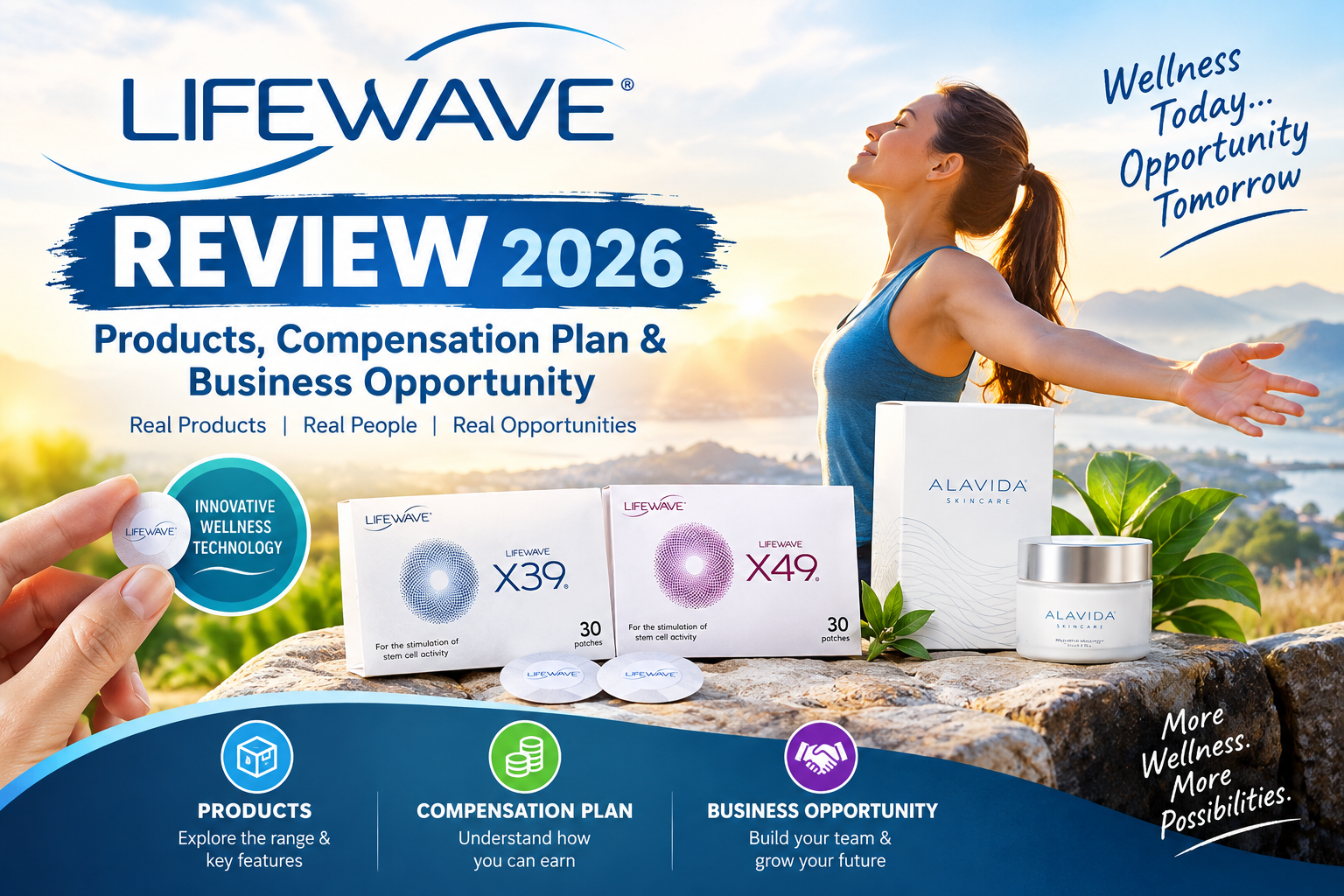
LifeWave is a wellness company that markets wearable patches and other wellness-related products through its website and a network of independent Brand Partners. The company promotes its technology as a phototherapy-based approach to general wellness and offers a business opportunity for people interested in product sales and network marketing.
If you are researching LifeWave in, two questions deserve particular attention: Are its products suitable for your personal wellness goals, and does its business opportunity make sense for your financial circumstances?
This LifeWave Review examines the company's product range, its explanation of phototherapy, its compensation structure, and the practical considerations prospective customers and Brand Partners should understand. Rather than relying exclusively on promotional claims or individual testimonials, this review emphasizes official company information, transparent expectations, and independent evaluation.
LifeWave's official website is the best starting point for checking its current products, regional availability, customer policies, and business opportunity information.
LifeWave presents itself as a wellness technology company focused on products designed for everyday vitality, activity, movement, sleep, skincare, and general well-being. Its portfolio includes wearable patches and other products intended to complement a wellness-focused lifestyle.
The company also operates a Brand Partner program. Participants can share products with customers and may qualify for compensation under the applicable company plan.
LifeWave's product catalog and business arrangements may differ between countries. Anyone considering a purchase or enrollment should therefore consult the official website for their location rather than assume that prices, policies, or compensation rules are identical worldwide.
LifeWave's product range includes several patch products and additional wellness and skincare offerings. Product names, availability, and prices can change, so the company's current catalog should be checked before making a buying decision.
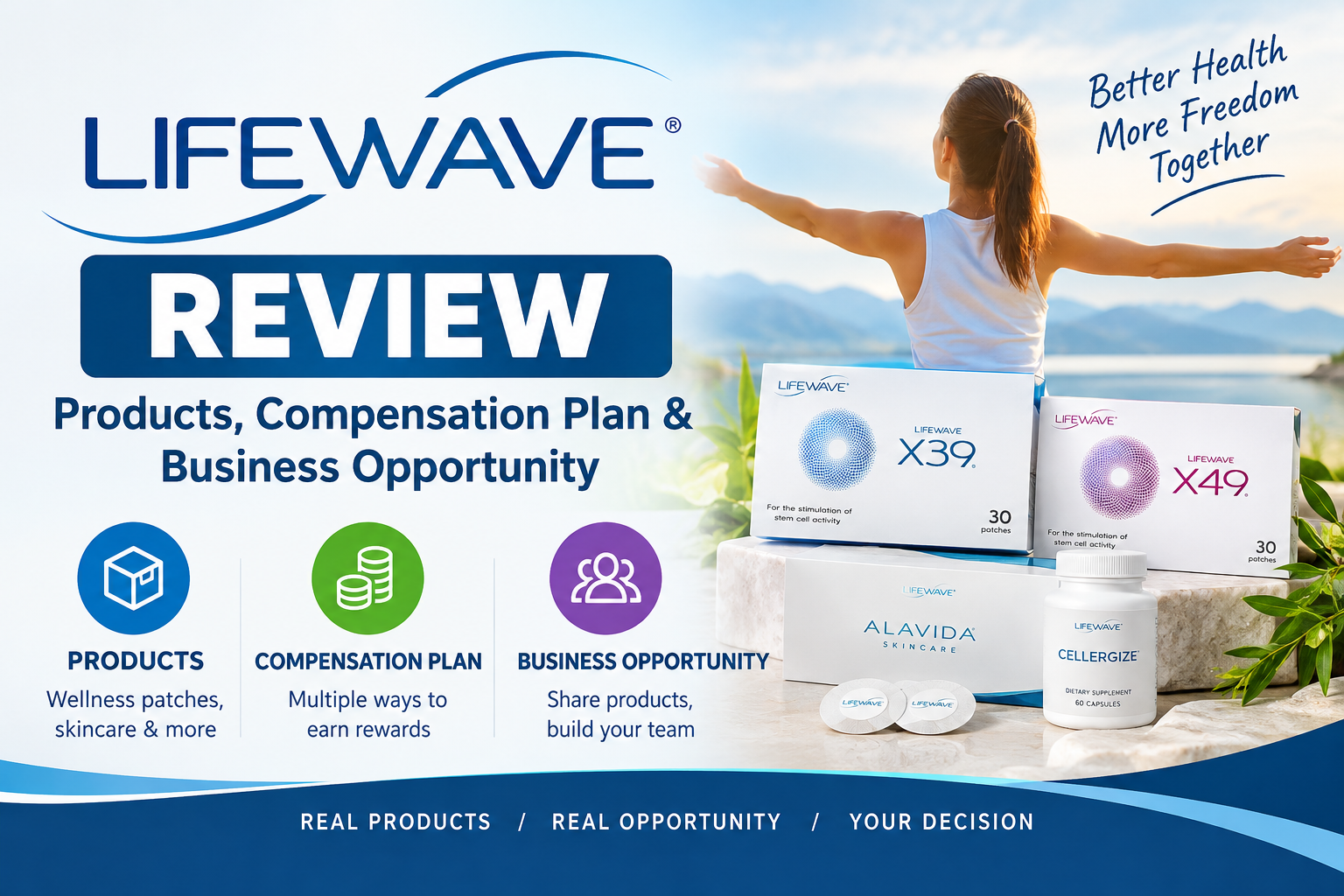
X39 is one of LifeWave's best-known products. The company describes it as a non-transdermal wearable patch that uses its proprietary phototherapy approach. Its marketing discusses general wellness, energy, strength, stamina, and exercise performance.
These descriptions explain how the company positions the product; they should not automatically be interpreted as proof that every advertised benefit has been independently established. Consumers should review the evidence available for specific claims and discuss health concerns with a qualified healthcare professional.
X49 is another wearable patch in the company's product portfolio. It is marketed as part of LifeWave's range of wellness and activity-related products.
Before comparing X49 with X39 or another patch, review the current product descriptions, intended use, instructions, and price. Avoid assuming that two products have identical ingredients, mechanisms, or evidence simply because they belong to the same brand.
LifeWave also lists products and product lines related to nutrition, skincare, and everyday wellness. Depending on the market, its catalog may include products such as Cellergize and items from the Alavida range.
The most appropriate comparison is based on the intended use, ingredients where applicable, instructions, cost, and available supporting evidence. A product's popularity or its inclusion in a bundle does not necessarily establish that it is right for every consumer.
Product research tip: Check the product's official listing for its current price, subscription terms, directions, return conditions, and any applicable warnings before ordering.
LifeWave describes its patches as non-transdermal products designed to interact with the body's emitted infrared energy. According to the company's explanation, the patches reflect certain wavelengths of energy back toward the skin.
This is the company's stated explanation of its technology. Understanding the proposed mechanism is different from establishing that a product delivers a particular clinical outcome.
When evaluating phototherapy-related claims, look for reliable human research that directly examines the specific product and the outcome being claimed. Evidence about light-based therapies in general cannot automatically establish the effectiveness of every wearable patch or proprietary technology.
Consumers should be particularly careful with claims that a wellness product can treat a medical condition, reverse disease, or replace prescribed treatment. Do not stop or delay medical care because of a product testimonial or marketing statement.
For additional context, review the product information and disclaimers published on LifeWave's official website, along with independent scientific evidence relevant to the exact claim.
Price is an important part of any product review. LifeWave's website displays product prices and may offer different purchasing options, including subscription-based pricing for eligible products.
However, prices can change and may vary by country, currency, shipping destination, taxes, and purchasing arrangement. A price displayed on a US product page should not be treated as the current price for a customer in another country.
Before placing an order, confirm:
LifeWave's X39 product page describes different initial money-back arrangements for retail or preferred customers and Brand Partners, as well as other return conditions. These terms are subject to the company's applicable policies and should be verified before purchase.
A sensible approach is to calculate the total cost over the period you expect to use the product, rather than focusing only on a discounted first order.
LifeWave invites people to join its business as Brand Partners. According to the company's official opportunity information, Brand Partners can share products, build customer relationships, and develop teams of other Brand Partners.
The company describes its compensation plan as providing multiple ways to qualify for rewards. Actual eligibility depends on the current plan, applicable qualifications, customer and team activity, and the rules in the participant's market.
Prospective participants should obtain the latest official compensation plan and understand its terminology before enrolling. In particular, they should determine:
Do not assume that every Brand Partner qualifies for every compensation method. A plan can describe possible ways to earn without guaranteeing that an individual will receive compensation.
Important: The compensation plan describes the rules for potential payments; it does not, by itself, establish what a typical participant earns after expenses.
LifeWave's Brand Partner program may appeal to people interested in direct selling, wellness products, and customer relationship building. However, joining a network marketing business does not guarantee income or profitability.
Results can depend on customer demand, the ability to make genuine retail sales, time spent on the business, expenses, applicable compensation rules, and other factors. Gross commissions are not the same as net profit.
Before joining, request and read the latest official LifeWave Earnings Disclosure Statement for the relevant country. Examine what the figures measure, which participants are included, the period covered, and whether the information reflects expenses or only company-paid compensation.
Prepare a realistic budget that includes all applicable costs, such as enrollment, products purchased for personal use or resale, shipping, travel, marketing tools, and other business expenses. Do not spend money that you cannot afford to lose, and do not borrow money based on an expectation of future commissions.
Be cautious of social media posts or presentations that promise financial freedom, unusually high earnings, or guaranteed results. Individual success stories do not establish what a new participant is likely to achieve.
For a useful general framework, the US Federal Trade Commission's Business Guidance Concerning Multi-Level Marketing discusses misleading product and earnings claims, including why expenses and typical results matter.
Several features may be worth exploring, depending on a person's needs and expectations.
A defined product portfolio: Customers can review a range of wellness and skincare products rather than relying on a single item.
An established company website: Official product pages and customer resources provide a starting point for checking product information, ordering terms, and company policies.
A sales-based business model: People interested in direct selling may appreciate the opportunity to develop customer relationships and share products they understand.
Access to official business resources: LifeWave provides Brand Partner information and a compliance resource center that can help participants understand company rules and permitted claims.
These are potential advantages to investigate, not guarantees of product effectiveness, customer satisfaction, or business success.
A balanced LifeWave review should also examine the potential disadvantages.
Product evidence: Consumers should distinguish company descriptions from independent evidence supporting specific health or performance outcomes.
Ongoing costs: Subscriptions, product purchases, shipping, and business expenses can affect affordability and profitability.
Income uncertainty: Compensation depends on applicable plan requirements and business results. Earnings should never be assumed or guaranteed.
Customer demand: A sustainable business requires genuine demand for the products. Recruiting new participants alone should not be treated as proof of long-term retail demand.
Policy and market differences: Product availability, prices, return policies, enrollment requirements, and compensation rules may vary by country and can change over time.
Marketing compliance: Brand Partners need to follow the company's current rules and applicable laws. Unsupported medical claims and misleading income representations can create serious problems.
The right decision depends on the evidence, costs, terms, and expectations that apply to your particular situation.
A useful assessment should separate the existence of a company and its products from questions about product effectiveness and business profitability.
LifeWave maintains an official website, lists products for sale, and publishes information about its Brand Partner program. Those facts can be checked directly through its official resources. They do not, on their own, prove every product claim or establish that participants generally make a profit.
To assess the opportunity fairly, review the current company policies, the compensation plan, the earnings disclosure, customer terms, and relevant independent evidence. Check whether the claims made by an individual promoter match the company's authorized materials.
For readers in the United States, the FTC's MLM guidance explains that product and earnings representations should be truthful, substantiated, and not misleading. Its guidance is useful context when evaluating any network marketing opportunity, including LifeWave.
A careful review should not label a business successful or unsuccessful solely on the basis of testimonials, online criticism, or promotional material. Instead, readers should evaluate the relevant evidence and decide whether the products and business arrangements fit their needs.
LifeWave products may be worth researching for consumers who are interested in the company's specific wellness offerings and are prepared to evaluate their cost, intended use, and supporting evidence.
The Brand Partner opportunity may interest people who enjoy product education, customer service, and direct selling, provided they understand the compensation rules and are comfortable with the financial uncertainty.
It may be unsuitable for anyone who expects guaranteed income, needs an immediate reliable source of earnings, cannot comfortably afford the potential costs, or intends to rely on patches instead of appropriate medical care.
Before making a decision, take time to compare alternatives and ask questions. A responsible decision is based on realistic expectations, not pressure to purchase or enroll quickly.
LifeWave is a wellness company that markets wearable patches and other wellness-related products. It also offers a Brand Partner program through which participants can share products and may qualify for compensation under the applicable plan.
X39 and X49 are wearable patches marketed by LifeWave. Their product descriptions and intended uses should be checked on the official website. Claims about particular outcomes should be evaluated against reliable evidence for the specific product.
No product or business result should be assumed to be guaranteed. Individual experiences may differ, and customers should review product information while prospective Brand Partners should study the compensation plan and official earnings disclosure.
LifeWave describes a compensation plan for eligible Brand Partners involving customer and team activity. The specific methods, qualifications, and payment rules should be confirmed using the latest official plan for the participant's country.
Brand Partners may qualify for compensation under the plan, but joining does not guarantee earnings or profit. A prospective participant should review the official earnings disclosure and calculate possible expenses before enrolling.
Availability and purchasing conditions can vary by market. Use the official LifeWave website for your country to check which products, prices, and policies apply.
Visit LifeWave's official website for product listings, Brand Partner information, customer policies, and links to relevant company resources.
LifeWave combines a wellness product portfolio with a direct-selling business opportunity. For customers, the key questions are whether a particular product fits their needs, whether the claims are supported, and whether the total price and terms are acceptable. For prospective Brand Partners, the additional questions are whether there is realistic customer demand, how the compensation plan works, and what the business may cost after expenses.
There is no single answer that will suit every consumer or prospective participant. The strongest approach is to review current official documentation, evaluate relevant independent evidence, understand the applicable policies, and avoid unsupported medical or earnings claims.
MLMScores' perspective: A responsible LifeWave review should help readers make informed decisions rather than encourage them to buy or enroll based on exaggerated promises. Verify the latest company information before acting, and remember that neither a wellness product nor a network marketing opportunity guarantees a particular outcome.
Published By -ADMiN