Basic SHIFT Membership
$99/month
Recurring subscription
- 20,000 AI credits per month
- Access to the AI tools suite
- Online cancellation option


Published On - October 24,2026
When purchasing a wellness product, customers want to know whether the product they receive matches the manufacturer's description and comes through an appropriate sales channel. Packaging, labeling, order documentation, and seller information can all help customers investigate a product's authenticity.
People searching for IGNYT product authenticity may be concerned about counterfeit products, unclear product origins, damaged packaging, or differences between advertised and delivered items.
IGNYT is presented through ORYGN as a powdered wellness drink. However, a product description or an online advertisement alone cannot establish the authenticity of an individual package. Customers should verify the product through reliable company information and inspect the item they receive.
This guide explains how to check product details, what warning signs to investigate, and what steps to take if an IGNYT order appears questionable.
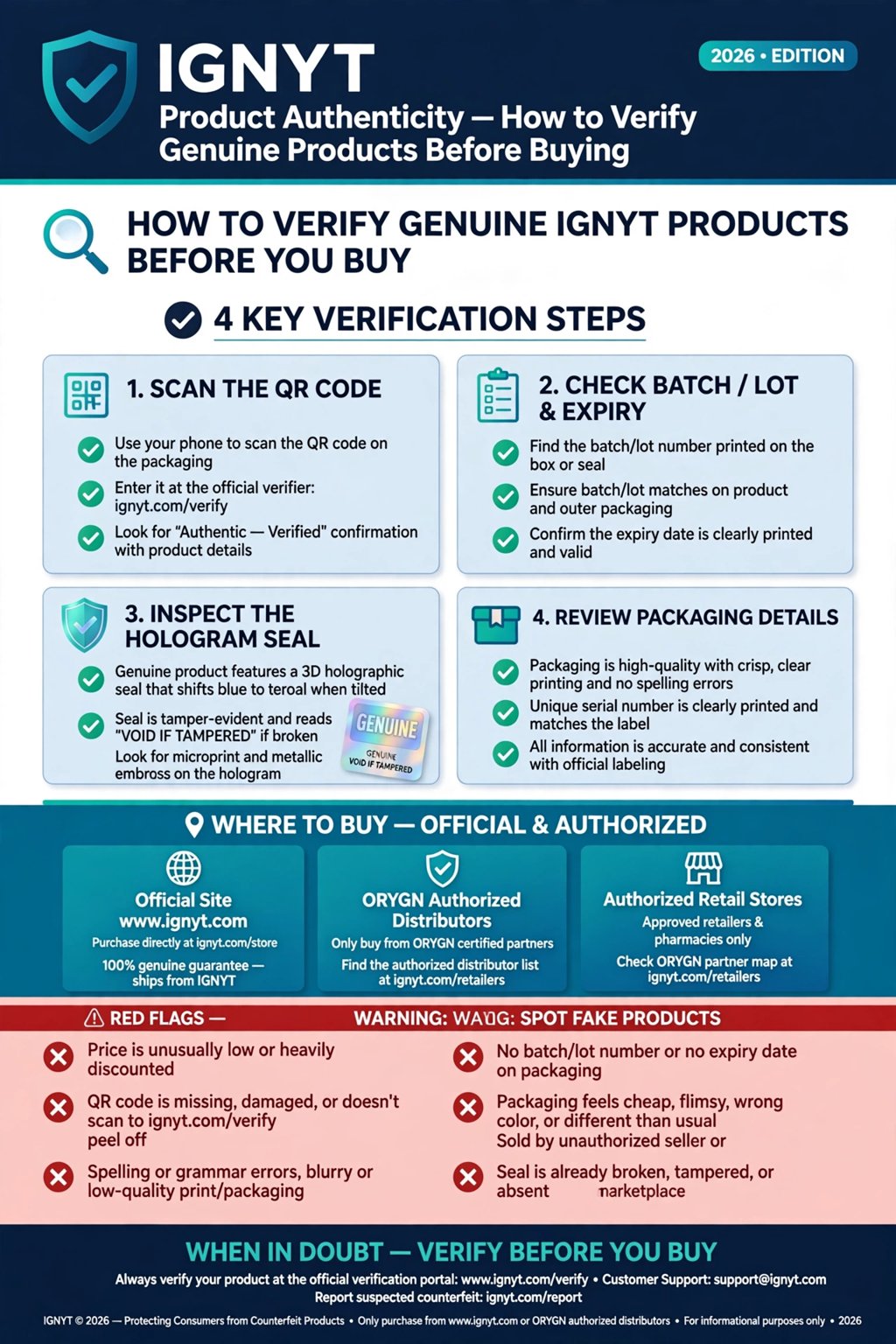
Product authenticity refers to whether an item is genuinely associated with the stated manufacturer or brand and whether it matches the product represented by the seller.
Authenticity is different from product effectiveness. A genuine product is not automatically proven to deliver every advertised benefit. Similarly, a product's appearance alone cannot establish its safety, quality, or manufacturing history.
When evaluating IGNYT, consider three separate questions:
Keeping these questions separate helps customers avoid treating a product's branding as proof of its performance.
One of the first steps is to establish where the product is being sold.
Start with the official ORYGN website and verify whether the seller or distributor is recognized by the company. If purchasing through a distributor, ask how the order will be processed and whether you will receive an official order confirmation.
Before paying, verify:
These checks can reduce uncertainty, but purchasing from a recognized source does not independently prove every aspect of product quality.
Be cautious if a seller refuses to identify themselves, asks you to pay an unrelated person without explanation, or cannot provide basic order documentation.
When your order arrives, examine the packaging before opening it.
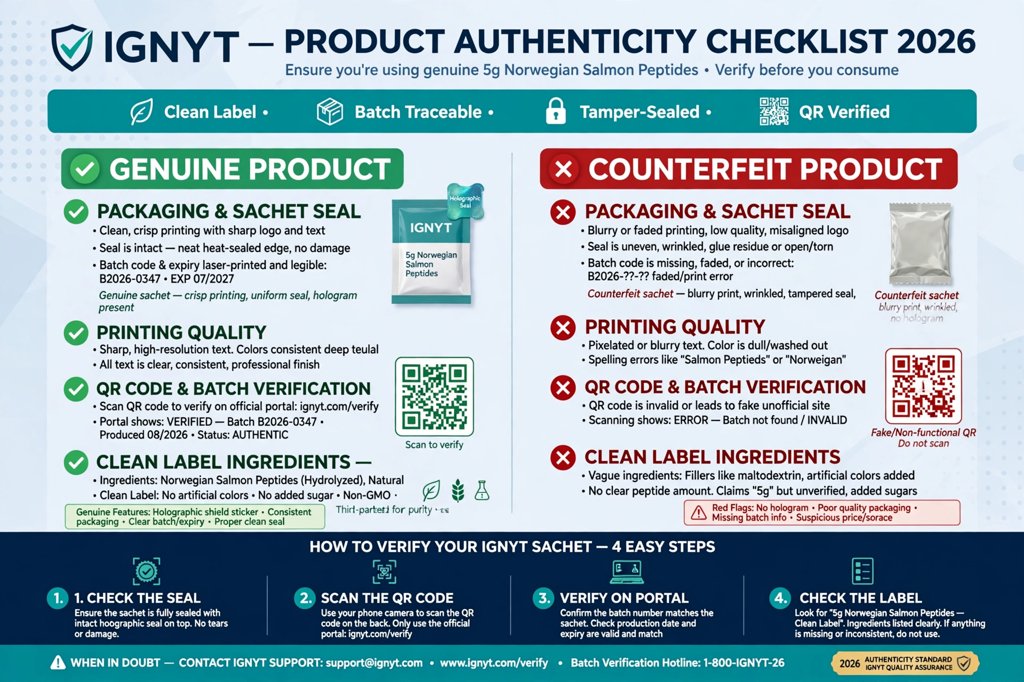
Compare the product name, package size, label details, and general presentation with current official product information. IGNYT has been described as a powdered drink supplied in individual serving sachets, but packaging can vary by product version or market.
Do not assume that every difference proves a product is counterfeit. Packaging may change over time, and market-specific versions may have different labeling requirements.
If something looks unusual, compare it with reliable information from the company or ask the company to confirm whether the packaging is consistent with the current product.
Pay attention to:
These are reasons to investigate, not conclusive proof of counterfeiting.
Batch identification can help a manufacturer trace a product to a particular production batch. Expiry or best-before information helps customers understand the product's stated usable period.
Check the package for a batch or lot number and the applicable date information. Confirm that the details are legible and that the packaging does not appear to have been altered.
If the batch number is missing, damaged, or inconsistent across the package, ask the company whether it can verify the product.
Do not assume that a printed batch number proves authenticity on its own. Such details may need to be confirmed through the manufacturer. Likewise, a product that has not expired is not automatically genuine or properly stored.
The ingredient label is another useful point of comparison.
IGNYT has been described as a powdered wellness drink whose product information refers to bioactive peptides. That description alone does not establish the complete formulation, ingredient quantities, or labeling requirements for every market.
Compare the label on your package with the current official ingredient information applicable to your product.
Check whether the information is clear and whether the package includes relevant usage instructions, warnings, and storage details.
If the ingredient list differs from the information you were given, do not immediately conclude that the product is counterfeit. Product formulations and labeling can change, and requirements may differ across countries. Instead, request clarification from the company before using the product.
Do not consume a product if the label is missing essential information, the package appears tampered with, or you have unresolved safety concerns.
A price that is substantially lower than the price offered through recognized channels may justify additional investigation.
However, price alone cannot determine authenticity. Discounts, promotions, regional pricing, and shipping arrangements can affect the final amount.
Before purchasing a discounted IGNYT product, ask the seller to explain the price and provide verifiable ordering details. Compare the final cost, including delivery charges, with the current price information available through official channels.
Be particularly cautious if a seller combines an unusually low price with pressure to pay immediately, incomplete product information, or an unwillingness to provide an order receipt. Avoid making a purchase solely because a seller claims the discount will disappear within minutes.
Once the product arrives, compare it with the order confirmation.
Check that the product name, quantity, and package size match what you purchased. Inspect the outer carton and individual sachets for damage or signs of tampering.
Photograph the package if you notice a discrepancy. Keep the shipping label, receipt, and other order documentation until you are satisfied that the order is correct.
If the product differs from the advertised item, contact the seller or company through a verifiable official channel. Explain the discrepancy clearly and ask for instructions. Do not discard the packaging before the issue is resolved, because the company may need identifying information to investigate the matter.
An authenticity check is only one part of responsible product evaluation.
Even if a package is genuine, consumers should still review the ingredients, directions for use, warnings, and available evidence supporting the product's claims. For a wellness drink, the suitability of the product may depend on its formulation and an individual's circumstances.
If you have a medical condition, take medication, have relevant allergies, or are pregnant or breastfeeding, consult a qualified healthcare professional when appropriate.
Do not interpret a genuine brand name, an intact package, or a positive testimonial as proof that a product is safe for every person. Similarly, do not rely on IGNYT as a substitute for prescribed medical treatment.
Online listings may contain incomplete descriptions, outdated images, or claims that are not supported by official product information.
Before ordering IGNYT online, check whether the listing clearly identifies the product and seller. Look for consistency between the advertised item and the details provided at checkout. Review the return terms before paying and retain a copy of the listing or order confirmation where practical.
Be cautious if an advertisement:
These signs do not establish that a particular listing is fraudulent, but they justify additional caution.
If you believe an IGNYT package may not be genuine, take a methodical approach:
Avoid publicly accusing a seller of counterfeiting without sufficient evidence. Describe the facts you can document and allow the issue to be investigated.
Before placing an order, consider asking:
Clear answers can help you decide whether you have enough information to proceed.
Start by checking the seller, order documentation, packaging, batch information, and current official product details. If you remain uncertain, ask the company to verify the specific product.
No. Packaging is one useful indicator, but appearance alone cannot conclusively establish authenticity. Manufacturer verification may be necessary.
No. Discounts can have legitimate explanations. Investigate unusually low prices alongside the seller's identity, product details, payment arrangements, and order documentation.
Contact the seller or company before using the product. Ask whether the package is consistent with the current product and whether its batch information can be verified.
No. Authenticity and effectiveness are different questions. Specific product claims should be assessed using reliable evidence relevant to the finished formulation.
Published By -Admin
Published On - October 24,2026
Promoting a wellness product through social media, personal recommendations, and online content can help distributors introduce potential customers to a business opportunity. However, responsible marketing requires more than creating attractive posts or sharing positive experiences.
For people researching IGNYT through ORYGN, understanding IGNYT distributor marketing rules is an important step before publishing promotional content. Product descriptions, wellness statements, customer testimonials, and income-related claims can influence purchasing decisions. If these statements are inaccurate or misleading, they may create legal, reputational, and business risks.
This guide explains the marketing practices prospective and current distributors should understand before promoting IGNYT. It is a general educational resource, not a statement of IGNYT's official policies. Distributors should confirm the latest company requirements and applicable laws before publishing content.
Marketing rules help establish boundaries around what distributors can say, how they can promote products, and how they should represent a business opportunity.
In network marketing, distributors may promote products independently while operating within a company's policies. That combination makes it especially important to distinguish personal opinions from authorized product information.
A distributor might create a social media post, publish a blog article, record a video, or speak with a potential customer. Regardless of the format, the information should be truthful, clear, and supported by reliable evidence.
Before promoting IGNYT, review the official distributor agreement, product information, brand guidelines, compensation documentation, and any available social media policy. Do not assume that a marketing technique is permitted simply because another distributor uses it.
Product marketing should explain what a product is and what the company says it is designed to do without exaggerating its properties.
When describing IGNYT, distributors should rely on current official product information for details such as ingredients, serving instructions, intended use, packaging, and other product characteristics.
Avoid adding claims that are not supported by the product label or reliable evidence. For example, a general description of a wellness product is different from a promise that it will produce a particular medical result. A personal impression is also different from a scientifically established outcome.
Before publishing a product description, ask:
If a claim cannot be verified, leave it out until reliable information is available.
Health-related marketing requires particular attention because customers may use product information when making decisions about their wellbeing.
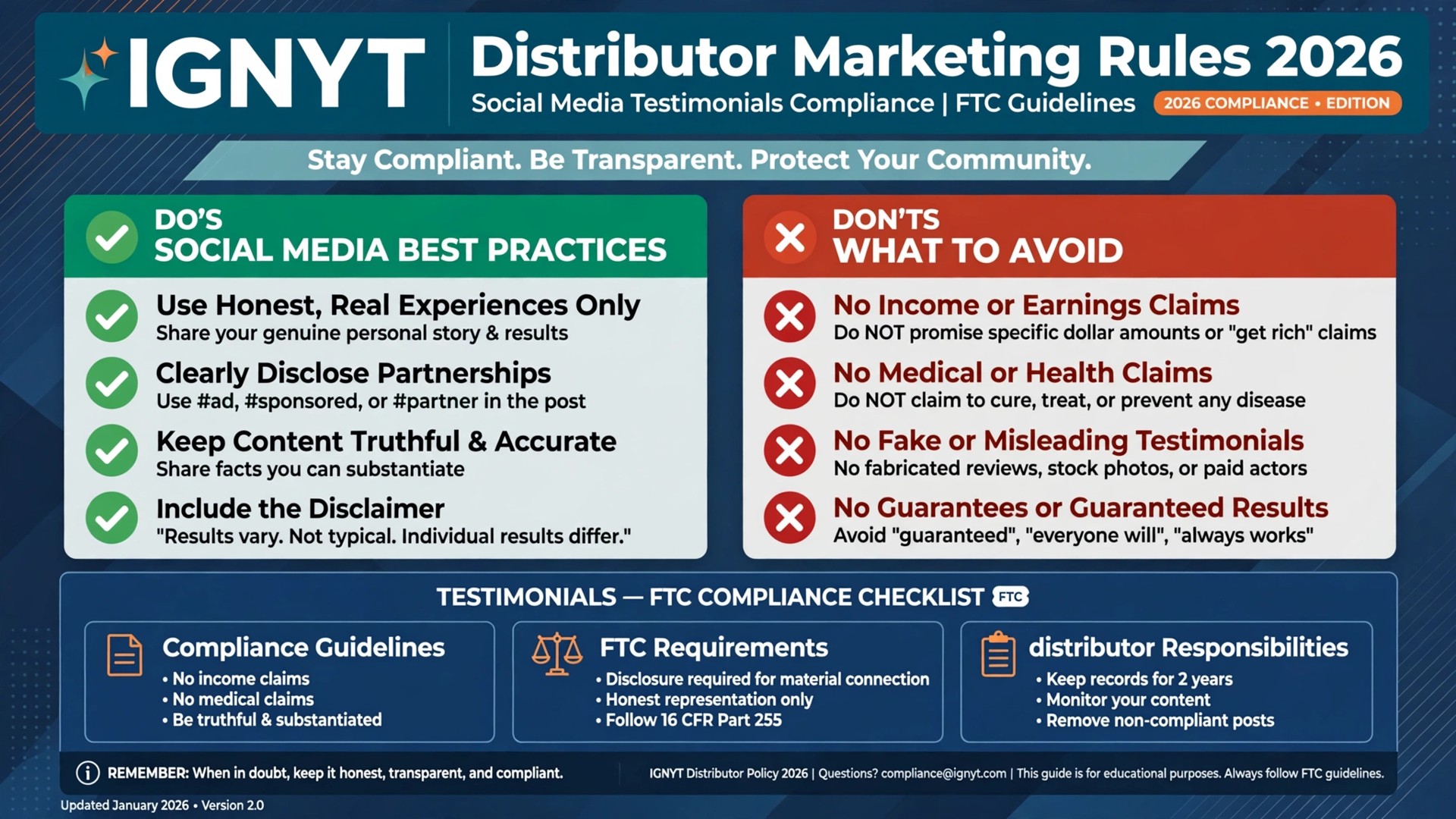
Distributors should not describe IGNYT as diagnosing, treating, curing, or preventing a disease unless the claim is legally permitted and supported by the appropriate evidence and authorization.
Avoid statements that suggest a wellness product replaces prescribed medication, professional medical care, or an established treatment.
Statements about metabolism, energy, weight management, hormones, blood sugar, or other physiological outcomes may also require substantiation. The fact that a product is marketed for wellness does not automatically establish that every advertised benefit has been proven.
A safer approach is to describe verified product characteristics accurately and avoid promising specific health outcomes.
A disclaimer does not automatically make an otherwise misleading health claim acceptable. The main promotional message itself must be truthful and appropriately supported.
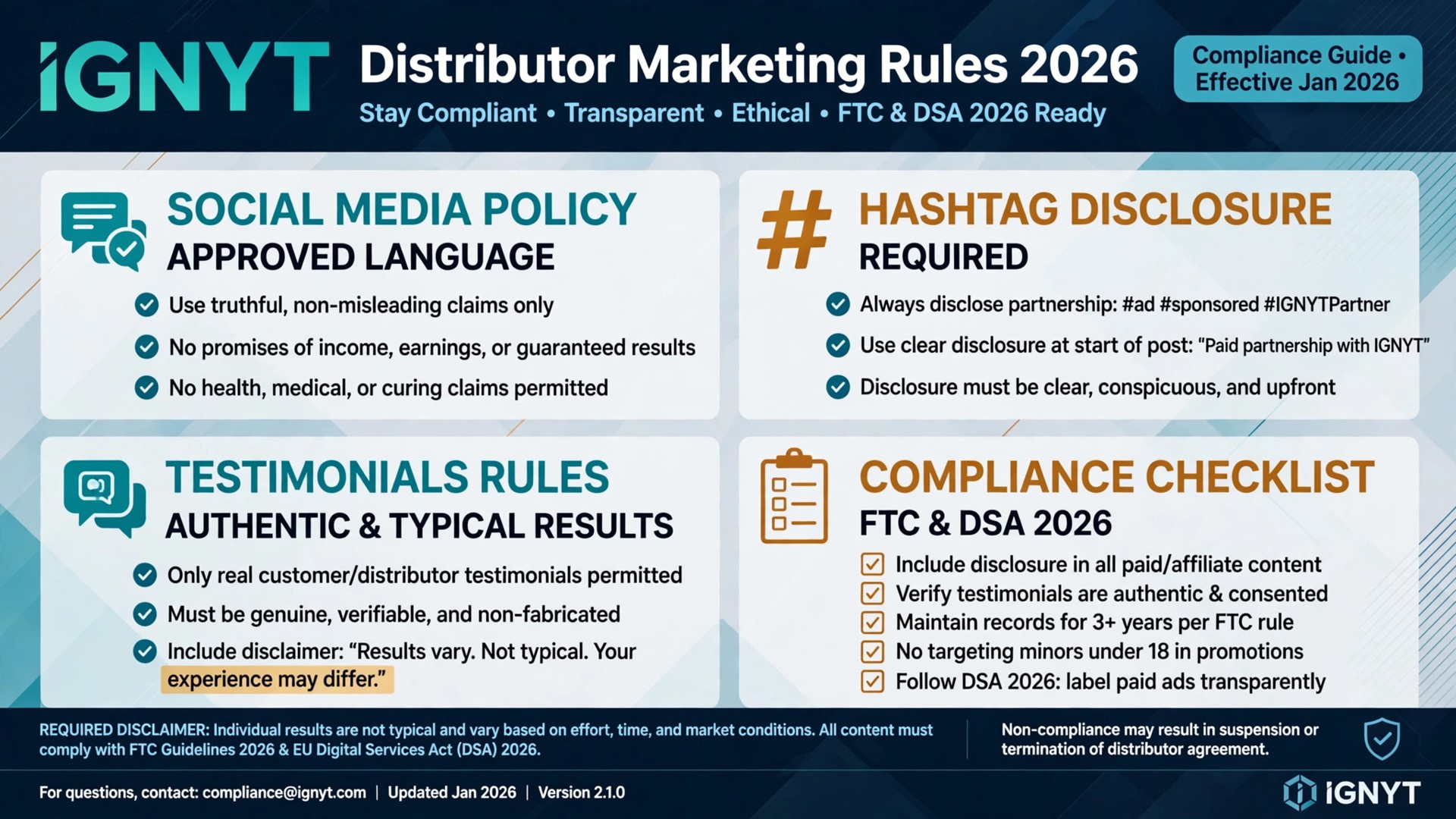
Customer testimonials can help prospective buyers understand other people's experiences. However, testimonials should not be presented as proof that every customer will achieve the same outcome.
If you share a customer review, make sure you have permission to publish it and do not change its meaning. Do not invent customer stories, fabricate quotations, or present a fictional experience as a genuine review.
Pay particular attention to testimonials describing dramatic health improvements, significant weight loss, or financial success. Such statements can create expectations that are not representative of typical outcomes.
Before publishing a testimonial, consider the following:
If a testimonial contains a claim you cannot substantiate, do not assume that attributing it to a customer removes your responsibility for publishing it.
Distributors may want to explain how the IGNYT business opportunity works. Any discussion of potential earnings should be especially careful.
Avoid promising that someone will earn a particular amount, replace a salary, become financially independent, or generate passive income without supporting evidence and appropriate qualifications.
Statements such as “anyone can earn thousands,” “guaranteed monthly income,” or “make money without effort” can create misleading expectations.
Before discussing potential compensation, review the current official compensation plan and any available income disclosure information. Confirm the eligibility requirements, expenses, qualifications, and conditions that apply.
If reliable information about typical earnings is unavailable, say so rather than estimating an income figure.
It is also important to distinguish revenue from profit. A distributor's gross commissions, if any, do not necessarily represent take-home earnings after product purchases, marketing expenses, travel, subscriptions, taxes, and other costs.
No distributor should imply that success is automatic or that recruiting people alone guarantees financial returns.
Social media can be useful for sharing product information, answering questions, and building customer relationships. It can also spread inaccurate claims quickly.
When promoting IGNYT on platforms such as Facebook, Instagram, TikTok, YouTube, or LinkedIn, focus on transparent and informative content.
Good practices include:
Check whether the company requires approval for particular advertisements, logos, product images, or promotional materials. If those rules are unclear, seek written guidance before publishing a campaign.
Do not assume that a personal social media account is exempt from advertising rules simply because the content is posted without payment.
Transparency matters when someone promotes a product from which they may receive commissions, bonuses, or other benefits.
If you are a distributor or otherwise have a financial relationship with IGNYT, make that relationship clear when required by applicable law, platform rules, or company policy.
A disclosure should be easy to notice and understand. Hiding it among unrelated hashtags or placing it where readers are unlikely to see it can reduce its usefulness.
For example, a straightforward disclosure might explain that you participate in the company's distribution program and may benefit if someone purchases through you. Use wording that accurately describes your actual relationship and compensation arrangement.
Do not describe yourself as an independent, unaffiliated reviewer if you have a financial interest in the transaction.
Comparisons can help customers evaluate different wellness products, but they should be based on relevant, verifiable information.
If comparing IGNYT with another product, check that the products are being compared on a fair basis. Relevant factors may include serving size, ingredient information, price per serving, package quantity, and documented product features.
Avoid unsupported claims that a competing product is unsafe, ineffective, inferior, or fraudulent.
Do not selectively present information in a way that creates a false impression. If a price comparison depends on a subscription, promotional offer, or particular purchase quantity, explain that condition.
A balanced comparison gives readers useful information without relying on insults, speculation, or unverified accusations.
Marketing should not come at the expense of personal privacy.
Before publishing a customer's photograph, testimonial, private message, or personal results, obtain appropriate permission. Be particularly careful with health-related details, order information, contact information, and other potentially sensitive data.
Avoid adding people to promotional mailing lists without an appropriate legal basis or consent where required. Do not purchase questionable contact lists or share customer details with other distributors unless the activity is authorized and legally appropriate.
When using email or text messages for marketing, follow applicable requirements for consent, identification, and opt-out requests. These practices help build trust and reduce the risk of complaints.
Official marketing materials can help distributors maintain consistent product descriptions and branding. However, the availability of a company image or presentation does not automatically mean it can be edited or reused in every context.
Check the applicable rules for:
Do not alter approved materials in a way that changes their meaning or adds unsupported promises. If you create original content, ensure it follows the company's current requirements.
If you are uncertain whether a particular advertisement is permitted, ask for clarification before investing money in a campaign.
A customer, company representative, platform moderator, or regulator may question a promotional statement. The appropriate response is to review the claim carefully rather than automatically defending it.
Start by locating the source supporting the statement. Check whether it is current, relevant, and strong enough to support the exact wording used.
If the claim is inaccurate or misleading, correct or remove it. If a customer has relied on the statement, respond honestly and provide appropriate clarification.
Keep records of the product information, approved materials, and relevant communications you relied on when preparing the content.
For questions involving potential legal violations or formal complaints, consider obtaining qualified professional advice.
Before publishing any IGNYT promotion, review this checklist.
This checklist is a general guide, not a substitute for the official IGNYT distributor rules or professional legal advice.
The current requirements should be confirmed through IGNYT's official distributor documentation, agreement, and marketing resources. Do not rely on unofficial summaries when making compliance decisions.
The permitted channels, branding rules, and advertising requirements should be checked against current company policies and the rules of each platform.
Personal experiences may be shared when truthful and appropriately presented, but they should not be used to imply unsupported medical benefits or guaranteed results.
Distributors should not make unsupported earnings promises. Any income discussion should accurately reflect available evidence, applicable qualifications, and relevant expenses.
No. A testimonial describes an individual's experience and does not, by itself, establish that a product produces the same outcome for others.
Review the official documentation and request written clarification from the company. Until the claim can be substantiated and confirmed as permitted, avoid publishing it.
Published By -Admin
Published On - October 20,2026
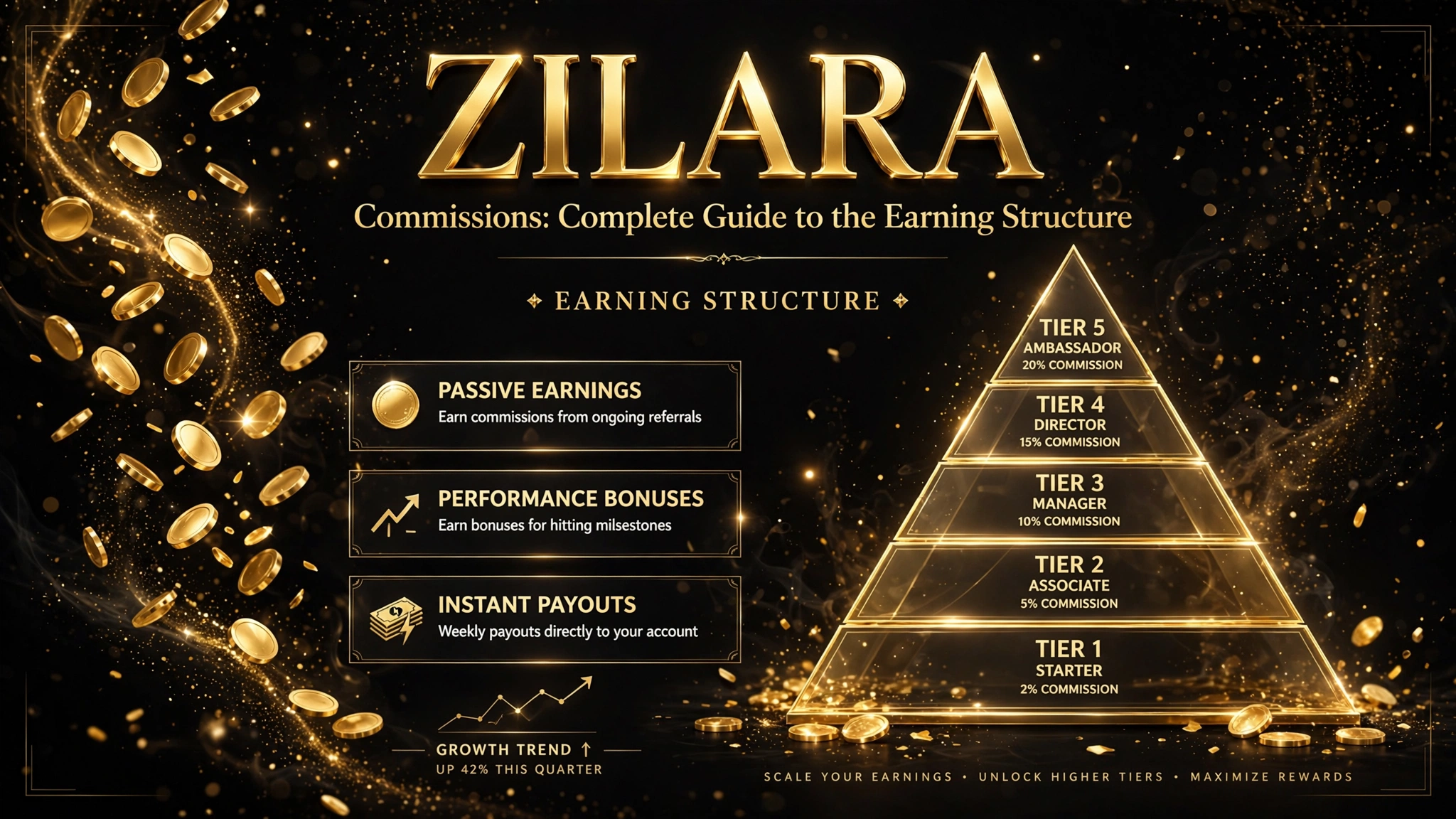
ZILARA offers a product-based business opportunity through which partners can earn commissions from product sales and may qualify for additional rewards by developing a customer base and building a team. The company's official compensation plan describes six income streams designed around retail sales, customer growth, team activity, leadership development, and qualifying product orders.
Understanding the commission structure is important for anyone considering the opportunity. Before joining, it is helpful to learn how each earning method works, what activity is required, which bonuses are available, and how personal performance affects eligibility.
This guide explains the main features of ZILARA's published compensation plan using information from its official website and compensation document.
According to ZILARA's official compensation plan, its earning structure is based on product sales and six potential income streams. These include Retail Rewards, Community Commissions, Team Commissions, Leadership Match, STAR Bonuses, and Leadership Bonuses.
Each stream has its own conditions. Some commissions are available through personally referred customer purchases, while others require specified personal volume, team activity, or leadership qualifications.
The company uses Business Volume (BV) to calculate and allocate qualifying product activity. BV is a plan-specific measure, so it should not automatically be treated as equal to a particular cash amount.
Read the official ZILARA compensation plan for the complete terms and qualifications.
Retail Rewards are the most straightforward earning method described in the plan.
According to the published plan, partners can earn a 30% commission on qualifying orders placed by personally referred customers. This retail commission does not require personal volume, a rank, monthly orders, or team building.
The basic process is:
Retail Rewards apply to customer orders, not orders placed by affiliates or distributors. The actual commission depends on eligible orders and the official calculation rules.
For example, if an eligible order has a commissionable basis of 100 units, a 30% commission on that basis would equal 30 units. This is a mathematical illustration, not a statement about the retail price or cash value of a specific ZILARA order.
The Community commission structure is designed to reward qualifying Business Volume across a two-position-wide matrix that can extend up to 15 levels.
The published plan specifies a 5% commission per eligible level, calculated on the first 10 BV of each qualifying order. The number of levels from which a participant can earn depends on their activity qualification.
The plan describes these personal-volume thresholds:
These thresholds are based on the plan's rolling 31-day activity rules. The matrix structure and percentage rate do not guarantee that every participant will earn commissions at every level. Actual earnings depend on qualifying orders, organizational activity, and the relevant conditions.
The Team commission system uses two sides, commonly called the left team and the right team. Qualifying Business Volume accumulates on both sides.
Under the published plan, a completed cycle consists of 100 BV on the left and 100 BV on the right. The plan describes the payout as 10% of the weaker leg per cycle, with the stated volume-based calculation rules.
To qualify for Team Commissions, a participant must maintain 50 BV of personal volume.
The key factors are:
The plan states that qualifying volume carries over between cycles while the account remains active. However, the amount earned depends on the weaker side and the actual qualifying volume. Building a large team alone does not guarantee a particular income.
Leadership Match is designed to reward partners who develop qualified leaders within their organization.
Under this structure, eligible participants can receive a percentage of qualifying Community and Team Commissions generated by members of their organization. The applicable percentage depends on rank and generation level.
The published plan lists the following leadership-match percentages:
These percentages describe the plan's rank-based matching structure, not a guaranteed percentage of all company sales. Leadership Match requires 100 BV personal volume and satisfaction of the applicable rank requirements.
The STAR program is designed to reward qualifying customer and affiliate order activity across an organization.
According to the official plan, an order of at least 100 BV can generate one STAR Credit when it meets the applicable requirements. Credits accumulate within the STAR structure, and payouts depend on the grid filling according to the plan's rules.
The published STAR payout schedule is:
To qualify for STAR earnings, participants must maintain 100 BV personal volume and meet the other applicable requirements.
The STAR structure resets monthly. Reaching a particular payout level is not automatic; it depends on qualifying orders, the placement of credits, rank eligibility, and the grid-filling conditions.
Leadership Bonuses are one-time rewards associated with achieving specified ranks.
The official compensation document lists the following bonus amounts:
The plan specifies that 50% of the bonus is paid after the rank achievement is verified. The remaining 50% is paid after the participant maintains the rank for three consecutive months, beginning with the month in which the rank was first achieved.
These are listed bonus amounts for qualifying rank achievements, not estimates of typical earnings. Eligibility depends on satisfying the rank requirements and maintaining the required activity.
Personal volume plays an important role in accessing the different commission streams.
The official getting-started guide explains that qualification is assessed over a rolling 31-day period. This means recent activity determines current eligibility rather than a simple calendar-month reset.
Before participating, it is important to understand:
You can review the official ZILARA getting-started guide for further information.
No. A published commission rate or bonus amount does not guarantee that a participant will earn that amount.
Actual results depend on customer demand, qualifying product orders, personal activity, team performance, applicable rank requirements, and business expenses. Product purchases and other costs can reduce or eliminate profit.
Before joining, prospective partners should read the complete compensation plan, understand the refund policy, and evaluate whether the opportunity makes sense for their circumstances. They should not borrow money or purchase products they cannot afford simply to qualify for a bonus.
The ZILARA compensation plan describes six potential earning streams: Retail Rewards, Community Commissions, Team Commissions, Leadership Match, STAR Bonuses, and Leadership Bonuses.
Each stream has different rules and eligibility requirements. Retail Rewards provide a way to earn through personally referred customer orders, while the other streams involve additional activity, organizational volume, or rank qualifications.
The best starting point is to understand the product offering, learn how commissionable volume is calculated, and review the official rules before making a financial commitment.
For the most accurate and complete information, consult the company's official compensation plan and confirm that its terms apply to your country and account.
.jpg)
Published By -Admin
Published On - October 20,2026
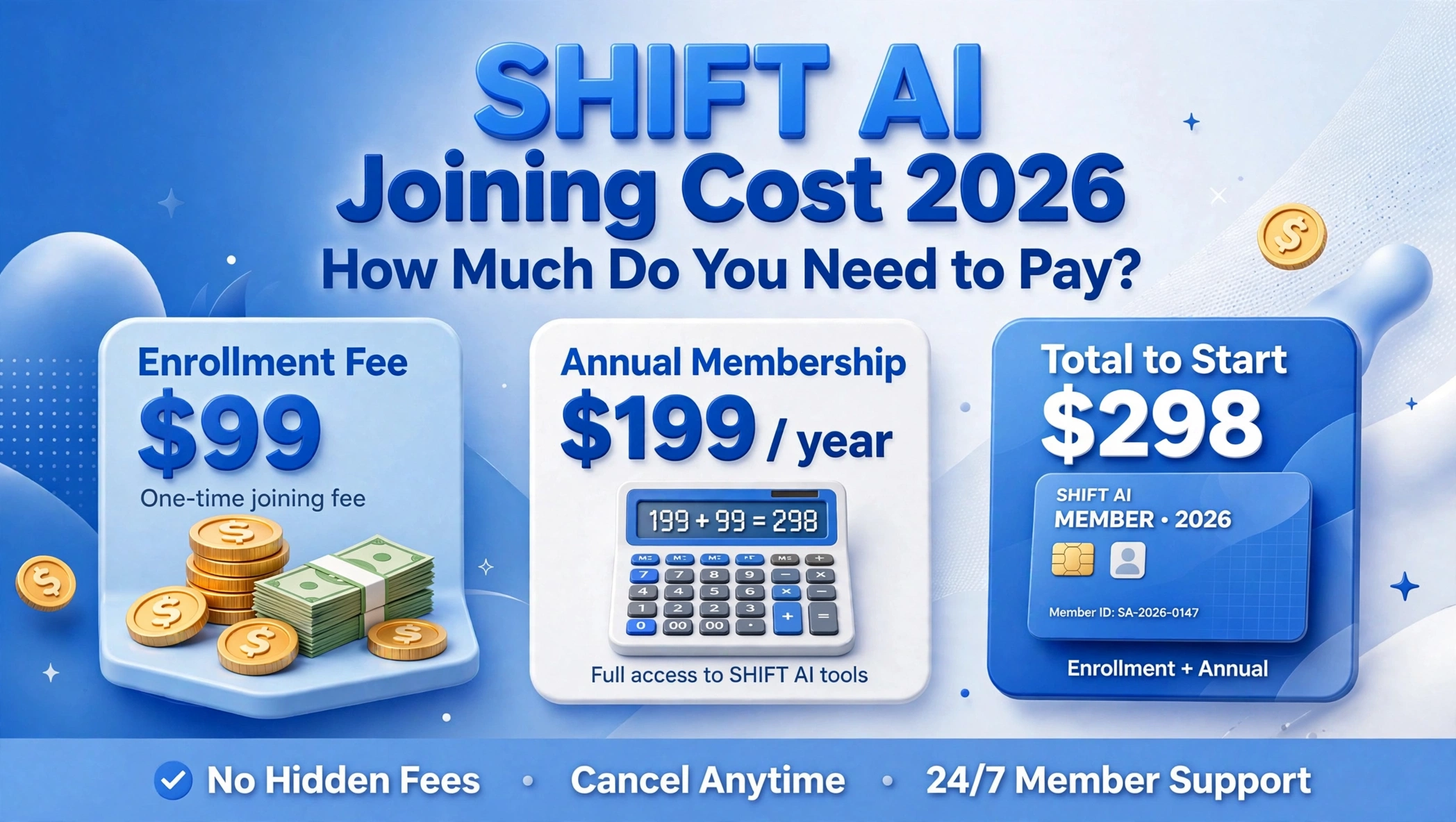
If you are planning to join SHIFT AI in 2026, it is important to understand the initial joining cost, monthly subscription, optional Club packages, and the conditions for earning rewards.
This guide discusses the published pricing and policies of SHIFT AI. All prices below are listed in US dollars (USD), not Indian rupees.
According to the published pricing information, SHIFT AI lists several membership options. The plans below summarize the prices provided for this article.
$99/month
Recurring subscription
$499 upfront
Then $99/month, starting in 30 days
$1,000 upfront
Then $99/month
$3,000 upfront
Then $99/month
$13,000 upfront
Then $99/month
Gold: $113,000 upfront
Platinum: $1,113,000 upfront
Each lists a subsequent $99 monthly charge.
Official pricing: SHIFT AI Membership Plans.
The following table summarizes the initial payment and subsequent monthly fee. Taxes, currency conversion charges, and other applicable costs are not included.
| Membership Plan | Initial Payment | Monthly Fee |
|---|---|---|
| SHIFT Membership | $99 for the first month | $99 |
| Standard Club | $499 | $99 after 30 days |
| Founder's Club | $1,000 | $99 |
| Bronze Club | $3,000 | $99 |
| Silver Club | $13,000 | $99 |
| Gold Club | $113,000 | $99 |
| Platinum Club | $1,113,000 | $99 |
If the monthly subscription remains $99 for 12 months:
The Standard Club requires an initial $499 payment, followed by the monthly subscription according to its published schedule. Confirm the exact billing dates before joining.
SHIFT AI advertises a collection of AI tools within one workspace. Features may include:
Membership plans include a specified quantity of AI credits. Different tasks may consume different amounts of credits. Check the current feature list and credit usage rules to understand what is included in your selected plan.
Visit the official SHIFT AI website for further information.
SHIFT AI describes five reward streams: CoachPay, ContentPay, CompetePay, CreditPay, and ClubPay. However, joining the platform does not guarantee an income.
The published income disclosure for June 25 to September 23, 2026, reportedly gives a median of $38.22 in gross earnings over 90 days among the active Club-member population. This figure is not profit because membership fees and other expenses are excluded. It also does not predict the earnings of a new member.
Review the company's official terms and income disclosures before making any financial decision.
Before paying a joining fee, carefully review the refund conditions and any applicable restrictions.
Read the policies before purchasing:
Whether SHIFT AI is worth joining depends on your intended use, available budget, and the value you receive from its AI tools.
Consider these points before making a decision:
If your primary goal is to use AI tools, consider whether the basic monthly membership offers enough value for your needs before committing to a more expensive Club package.
SHIFT AI's published membership options range from $99 per month to a $499 Standard Club payment followed by $99 per month. Higher Club tiers have substantially larger upfront costs.
Before joining, verify the current pricing, billing dates, included AI credits, reward eligibility, and refund rules. Make your decision based on the actual value of the service rather than an expectation of guaranteed earnings.
Official pricing page: shiftai.club/pages/plans
Disclaimer: This article is for informational purposes only and is not financial or investment advice. Prices and policies can change. Verify all information with SHIFT AI before making a payment.
https://shiftai.club/
Published By -Admin